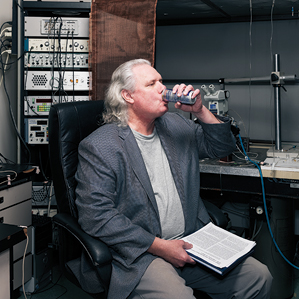
Theodore Berger, a biomedical engineer and
neuroscientist at the University of Southern California in Los Angeles,
envisions a day in the not too distant future when a patient with severe
memory loss can get help from an electronic implant. In people whose
brains have suffered damage from Alzheimer’s, stroke, or injury,
disrupted neuronal networks often prevent long-term memories from
forming. For more than two decades, Berger has designed silicon chips to
mimic the signal processing that those neurons do when they’re
functioning properly—the work that allows us to recall experiences and
knowledge for more than a minute. Ultimately, Berger wants to restore
the ability to create long-term memories by implanting chips like these
in the brain.
The idea is so audacious and so far outside the mainstream of
neuroscience that many of his colleagues, says Berger, think of him as
being just this side of crazy. “They told me I was nuts a long time
ago,” he says with a laugh, sitting in a conference room that abuts one
of his labs. But given the success of recent experiments carried out by
his group and several close collaborators, Berger is shedding the loony
label and increasingly taking on the role of a visionary pioneer.
Berger and his research partners have yet to conduct human tests of
their neural prostheses, but their experiments show how a silicon chip
externally connected to rat and monkey brains by electrodes can process
information just like actual neurons. “We’re not putting individual
memories back into the brain,” he says. “We’re putting in the capacity
to generate memories.” In an impressive experiment published last fall,
Berger and his coworkers demonstrated that they could also help monkeys
retrieve long-term memories from a part of the brain that stores them.
If a memory implant sounds farfetched, Berger points to other recent
successes in neuroprosthetics. Cochlear implants now help more than
200,000 deaf people hear by converting sound into electrical signals and
sending them to the auditory nerve. Meanwhile, early experiments have
shown that implanted electrodes can allow paralyzed people to move
robotic arms with their thoughts. Other researchers have had preliminary
success with artificial retinas in blind people.
Still, restoring a form of cognition in the brain is far more
difficult than any of those achievements. Berger has spent much of the
past 35 years trying to understand fundamental questions about the
behavior of neurons in the hippocampus, a part of the brain known to be
involved in forming memory. “It’s very clear,” he says. “The hippocampus
makes short-term memories into long-term memories.”
What has been anything but clear is how the hippocampus accomplishes
this complicated feat. Berger has developed mathematical theorems that
describe how electrical signals move through the neurons of the
hippocampus to form a long-term memory, and he has proved that his
equations match reality. “You don’t have to do everything the brain
does, but can you mimic at least some of the things the real brain
does?” he asks. “Can you model it and put it into a device? Can you get
that device to work in any brain? It’s those three things that lead
people to think I’m crazy. They just think it’s too hard.”
Cracking the Code
Berger often speaks in sentences that stretch to paragraph length and
have many asides, footnotes, and complete diversions from the point. I
ask him to define memory. “It’s a series of electrical pulses over time
that are generated by a given number of neurons,” he says. “That’s
important because you can reduce it to this and put it back into a
framework. Not only can you understand it in terms of the biological
events that happened; that means that you can poke it, you can deal with
it, you can put an electrode in there, and you can record something
that matches your definition of a memory. You can find the 2,147 neurons
that are part of this memory. And what do they generate? They generate
this series of pulses. It’s not bizarre. It’s something you can handle.
It’s useful. It’s what happens.”
This is the conventional view of memory, but it only scratches the
surface. And to Berger’s perpetual frustration, many colleagues who
probe this mysterious realm of the brain haven’t attempted to go much
deeper. Neuroscientists track electrical signals in the brain by
monitoring action potentials, microvolt changes on the surfaces of
neurons. But all too often, says Berger, their reports oversimplify
what’s actually taking place. “They find an important event in the
environment and count action potentials,” he says. “They say, ‘It went
up from 1 to 200 after I did something. I’m finding something
interesting.’ What are you finding? ‘Activity went up.’
But what are you finding?
‘Activity went up.’ So what? Is it coding something? Is it representing
something that the next neuron cares about? Does it make the next
neuron do something different? That’s what we’re supposed to be doing:
explaining things, not just describing things.”
If one neuron fires at a specific time and place, what exactly do the neighboring neurons do in response?

Berger takes a marker and fills a whiteboard from top to bottom with a
line of circles that represent neurons. Next to each one, he draws a
horizontal line that has a different pattern of blips on it. “This is
you in my brain,” he says. “My hippocampus has already formed a
long-term memory of you. I’ll remember you into next week. But how can I
distinguish you from the next person? Let’s say there are 500,000 cells
in the hippocampus that represent you, and there are all sorts of
things that each cell is coding—like how your nose is relative to your
eyebrow—and they code that with different patterns. So the reality of
the nervous system is really complicated, which is why we’re still
asking such basic, limited questions about it.”
Theodore Berger has spent his career trying to understand how neurons form memories.
In graduate school at Harvard, Berger’s mentor was Richard Thompson,
who studied localized, learning-induced changes in the brain. Thompson
used a tone and a puff of air to condition rabbits to blink their eyes,
aiming to determine
where the memory he induced was stored. The
idea was to find a specific place in the brain where the learning was
localized, says Berger: “If the animal did learn and you removed it, the
animal couldn’t remember.”
Thompson, with Berger’s help, managed to do just that; they published
the results in 1976. To find the site in the rabbits, they equipped the
animals’ brains with electrodes that could monitor the activity of a
neuron. Neurons have gates on their membranes, which let electrically
charged particles like sodium and potassium in and out. Thompson and
Berger documented the electrical spikes seen in the hippocampus as
rabbits developed a memory. Both the spikes’ amplitude (representing the
action potential) and their spacing formed patterns. It can’t be an
accident, Berger thought, that cells fire in a way that forms patterns
with respect to time.
This led him to a central question that underlies his current work:
as cells receive and send electrical signals, what pattern describes the
quantitative relationship between the input and the output? That is, if
one neuron fires at a specific time and place, what exactly do the
neighboring neurons do in response? The answer could reveal the code
that neurons use to form a long-term memory.
But it soon became clear that the answer was extremely complex. In
the late 1980s, Berger, working at the University of Pittsburgh with
Robert Sclabassi, became fascinated by a property of the neuronal
network in the hippocampus. When they stimulated the hippocampus of a
rabbit with electrical pulses (the input) and charted how signals moved
through different populations of neurons (the output), the relationship
they observed between the two wasn’t linear. “Let’s say you put in 1 and
get 2,” says Berger. “That’s pretty easy. It’s a linear relation.” It
turns out, however, that there’s “essentially no condition in the brain
where you get linear activity, a linear summation,” he says. “It’s
always nonlinear.” Signals overlap, with some suppressing an incoming
pulse and some accentuating it.
By the early 1990s, his understanding—and computing hardware—had
advanced to the point that he could work with his colleagues at the
University of Southern California’s department of engineering to make
computer chips that mimic the signal processing done in parts of the
hippocampus. “It became obvious that if I could get this stuff to work
in large numbers in hardware, you’ve got part of the brain,” he says.
“Why not hook up to what’s existing in the brain? So I started thinking
seriously about prosthetics long before anybody even considered it.”
A Brain Implant
Berger began working with Vasilis Marmarelis, a biomedical engineer at USC, to begin making a brain prosthesis (see “
Regaining Lost Brain Function”).
They first worked with hippocampal slices from rats. Knowing that
neuronal signals move from one end of the hippocampus to the other, the
researchers sent random pulses into the hippocampus, recorded the
signals at various locales to see how they were transformed, and then
derived mathematical equations describing the transformations. They
implemented those equations in computer chips.
Next, to assess whether such a chip could serve as a prosthesis for a
damage hippocampal region, the researchers investigated whether they
could bypass a central component of the pathway in the brain slices.
Electrodes placed in the region carried electrical pulses to an external
chip, which performed the transformations normally done in the
hippocampus. Other electrodes delivered the signals back to the slice of
brain.
“I never thought I’d see this go into humans, and now our discussions
are about when and how. I never thought I’d live to see the day.”
Then the researchers took a leap forward by trying this in live rats,
showing that a computer could in fact serve as an artificial component
of the hippocampus. They began by training the animals to push one of
two levers to receive a treat, recording the series of pulses in the
hippocampus as they chose the correct one. Using those data, Berger and
his team modeled the way the signals were transformed as the lesson was
converted into a long-term memory, and they captured the code believed
to represent the memory itself. They proved that their device could
generate this long-term memory code from input signals recorded in rats’
brains while they learned the task. Then they gave the rats a drug that
interfered with their ability to form long-term memories, causing them
to forget which lever produced the treat. When the researchers pulsed
the drugged rats’ brains with the code, the animals were again able to
choose the right lever.
Last year, the scientists published primate experiments involving the
prefrontal cortex, a part of the brain that retrieves the long-term
memories created by the hippocampus. They placed electrodes in the
monkey brains to capture the code formed in the prefrontal cortex that
they believed allowed the animals to remember an image they had been
shown earlier. Then they drugged the monkeys with cocaine, which impairs
that part of the brain. Using the implanted electrodes to send the
correct code to the monkeys’ prefrontal cortex, the researchers
significantly improved the animal’s performance on the
image-identification task.
Within the next two years, Berger and his colleagues hope to implant
an actual memory prosthesis in animals. They also want to show that
their hippocampal chips can form long-term memories in many different
behavioral situations. These chips, after all, rely on mathematical
equations derived from the researchers’ own experiments. It could be
that the researchers were simply figuring out the codes associated with
those specific tasks. What if these codes are not generalizable, and
different inputs are processed in various ways? In other words, it is
possible that they haven’t cracked the code but have merely deciphered a
few simple messages.
Berger allows that this may well be the case, and his chips may form
long-term memories in only a limited number of situations. But he notes
that the morphology and biophysics of the brain constrain what it can
do: in practice, there are only so many ways that electrical signals in
the hippocampus can be transformed. “I do think we’re going to find a
model that’s pretty good for a lot of conditions and maybe most
conditions,” he says. “The goal is to improve the quality of life for
somebody who has a severe memory deficit. If I can give them the ability
to form new long-term memories for half the conditions that most people
live in, I’ll be happy as hell, and so will be most patients.”
Despite the uncertainties, Berger and his colleagues are planning
human studies. He is collaborating with clinicians at his university who
are testing the use of electrodes implanted on each side of the
hippocampus to detect and prevent seizures in patients with severe
epilepsy. If the project moves forward as envisioned, Berger’s group
will piggyback on the trial to look for memory codes in those patients’
brains.
“I never thought I’d see this go into humans, and now our discussions
are about when and how,” he says. “I never thought I’d live to see the
day, but now I think I will.”

WHY IT MATTERS
Brain damage can cause people to lose the ability to form long-term memories.
BreakthroughAnimal experiments show it is possible to correct for memory problems with implanted electrodes.
Key Players• Theodore Berger, USC
• Sam Deadwyler, Wake Forest
• Greg Gerhardt,
University of Kentucky
• DARPA