Showing posts with label tech. Show all posts

April 29, 2015

China Plans to build Solar Space Station

A random space station illustration

China is planning to build a huge Solar Power Station 36,000 kilometers above the ground in an attempt to solve the increasing energy crisis, greenhouse effects and smog problems.

The power station would be a super spacecraft on a geosynchronous orbit equipped with huge solar panels. The electricity generated would be converted to microwaves or lasers and transmitted to a collector on Earth.

According to Wang Xiji, an academician of the Chinese Academy of Sciences and an International Academy of Astronautics member, the space power station would be really huge, with the total area of the solar panels reaching 5 to 6 sq km. That would be equivalent to 12 of Beijing's Tian'anmen Square, the largest public square in the world, or nearly two New York Central Parks.

The electricity generated from the ground-based solar plants fluctuates with night and day and the weather, but a space generator can collect energy 99 per cent of the time.Also, Space-based solar panels can generate ten times as much electricity as ground-based panels per unit area, says Duan Baoyan, a member of the Chinese Academy of Engineering.

It's also of great strategic significance as whoever gets hold of the technology first could occupy the future energy market. China plans to build this space station by year 2020.

Lamborghini Veneno - Most Expensive Collector's Item

An open racing prototype with an extreme design and breathtaking performance, Lamborghini Veneno is a Limited Production super car based off of the Lamborghini Aventador. Built to celebrate it's 50th anniversary, Lamborghini stated that there are going to be only 9 of Veneno released ever. One of these cars, dubbed Car Zero, is to be placed in Lamborghini's Museum as display vehicle.

April 28, 2015

Bloodborne Game Review

If you guys are a fan of Action, Role-playing and horror, then this game is absolutely meant for you. Bloodborne developed by From Software is a game that is unconventional in every way you see it.
Warning: Bloodborne is quite difficult, very playable, but does not dumb down the action. You will die a lot, however, that is one of the best parts of the game. Read on to find out more...

April 27, 2015

Aston Martin DB11 Concept Car

What is known more firmly is the engineering basis for the new car. It will use an all-new platform, upgrading Aston Martin's VH aluminium architecture to something called VH500 and pepped up with the latest modules of everything: new suspension and transmission updates, the carte-blanche electrical systems such as sat-navs and, we hear, a smattering of lightweight composites.

A3W Motiv Concept MotorBike

Now guys, This is another good concept I have seen around. This one is Trike Bike i.e. it has 3 tyres which are all part of basic design and not a modification.

French designer Julien Rondino’s three-wheeled motorcycle concept – the A3W Motiv.

We are waiting for more details on the bike. But for now, what we know is that the bike has been designed around KTM’s 999cc LC8 v-twin. The chassis seems to be a mix of cast aluminium and steel tube sections and the bike is packed with interesting bits – hub-centre steering, adjustable ergonomics and Buell-style perimeter brakes.

Here is the Link to an album of A3W Motiv's Pics.

April 26, 2015

Acura NSX comes up with really cool info...


At the Society of Automotive Engineers 2015 World Congress, Acura spilled some new details about the upcoming next-generation NSX. Befitting the audience, it was all very techno-nerdy.

April 24, 2015

The Suzuki Crosscage Concept MotorBike


Suzuki Crosscage Concept
The Suzuki Crosscage fuel celled motorcycle is a hydrogen powered prototype that exists now. Suzuki is putting the Crosscage through road testing with the goal of commercialization in less than 5 years. This joint venture of Suzuki and Intelligent Energy is really going to define Style with Clean fuel.

August 18, 2013

Deep Learning


Deep Learning


When Ray Kurzweil met with Google CEO Larry Page last July, he wasn’t looking for a job. A respected inventor who’s become a machine-intelligence futurist, Kurzweil wanted to discuss his upcoming book How to Create a Mind. He told Page, who had read an early draft, that he wanted to start a company to develop his ideas about how to build a truly intelligent computer: one that could understand language and then make inferences and decisions on its own.

It quickly became obvious that such an effort would require nothing less than Google-scale data and computing power. “I could try to give you some access to it,” Page told Kurzweil. “But it’s going to be very difficult to do that for an independent company.” So Page suggested that Kurzweil, who had never held a job anywhere but his own companies, join Google instead. It didn’t take Kurzweil long to make up his mind: in January he started working for Google as a director of engineering. “This is the culmination of literally 50 years of my focus on artificial intelligence,” he says.

Kurzweil was attracted not just by Google’s computing resources but also by the startling progress the company has made in a branch of AI called deep learning. Deep-learning software attempts to mimic the activity in layers of neurons in the neocortex, the wrinkly 80 percent of the brain where thinking occurs. The software learns, in a very real sense, to recognize patterns in digital representations of sounds, images, and other data.

The basic idea—that software can simulate the neocortex’s large array of neurons in an artificial “neural network”—is decades old, and it has led to as many disappointments as breakthroughs. But because of improvements in mathematical formulas and increasingly powerful computers, computer scientists can now model many more layers of virtual neurons than ever before.

With this greater depth, they are producing remarkable advances in speech and image recognition. Last June, a Google deep-learning system that had been shown 10 million images from YouTube videos proved almost twice as good as any previous image recognition effort at identifying objects such as cats. Google also used the technology to cut the error rate on speech recognition in its latest Android mobile software. In October, Microsoft chief research officer Rick Rashid wowed attendees at a lecture in China with a demonstration of speech software that transcribed his spoken words into English text with an error rate of 7 percent, translated them into Chinese-language text, and then simulated his own voice uttering them in Mandarin. That same month, a team of three graduate students and two professors won a contest held by Merck to identify molecules that could lead to new drugs. The group used deep learning to zero in on the molecules most likely to bind to their targets.

Google in particular has become a magnet for deep learning and related AI talent. In March the company bought a startup cofounded by Geoffrey Hinton, a University of Toronto computer science professor who was part of the team that won the Merck contest. Hinton, who will split his time between the university and Google, says he plans to “take ideas out of this field and apply them to real problems” such as image recognition, search, and natural-language understanding, he says.

All this has normally cautious AI researchers hopeful that intelligent machines may finally escape the pages of science fiction. Indeed, machine intelligence is starting to transform everything from communications and computing to medicine, manufacturing, and transportation. The possibilities are apparent in IBM’s Jeopardy!-winning Watson computer, which uses some deep-learning techniques and is now being trained to help doctors make better decisions. Microsoft has deployed deep learning in its Windows Phone and Bing voice search.

Extending deep learning into applications beyond speech and image recognition will require more conceptual and software breakthroughs, not to mention many more advances in processing power. And we probably won’t see machines we all agree can think for themselves for years, perhaps decades—if ever. But for now, says Peter Lee, head of Microsoft Research USA, “deep learning has reignited some of the grand challenges in artificial intelligence.”

Building a Brain


There have been many competing approaches to those challenges. One has been to feed computers with information and rules about the world, which required programmers to laboriously write software that is familiar with the attributes of, say, an edge or a sound. That took lots of time and still left the systems unable to deal with ambiguous data; they were limited to narrow, controlled applications such as phone menu systems that ask you to make queries by saying specific words.

Neural networks, developed in the 1950s not long after the dawn of AI research, looked promising because they attempted to simulate the way the brain worked, though in greatly simplified form. A program maps out a set of virtual neurons and then assigns random numerical values, or “weights,” to connections between them. These weights determine how each simulated neuron responds—with a mathematical output between 0 and 1—to a digitized feature such as an edge or a shade of blue in an image, or a particular energy level at one frequency in a phoneme, the individual unit of sound in spoken syllables.


Some of today’s artificial neural networks can train themselves to recognize complex patterns.


Programmers would train a neural network to detect an object or phoneme by blitzing the network with digitized versions of images containing those objects or sound waves containing those phonemes. If the network didn’t accurately recognize a particular pattern, an algorithm would adjust the weights. The eventual goal of this training was to get the network to consistently recognize the patterns in speech or sets of images that we humans know as, say, the phoneme “d” or the image of a dog. This is much the same way a child learns what a dog is by noticing the details of head shape, behavior, and the like in furry, barking animals that other people call dogs.

But early neural networks could simulate only a very limited number of neurons at once, so they could not recognize patterns of great complexity. They languished through the 1970s.


WHY IT MATTERS

Computers would assist humans far more effectively if they could reliably recognize patterns and make inferences about the world.

Breakthrough
A method of artificial intelligence that could be generalizable to many kinds of applications.

Key Players
• Google
• Microsoft
• IBM
• Geoffrey Hinton, University of Toronto

August 17, 2013

Smart Watches


Pebble Smart Watch
Pebble Smart Watches


Eric Migicovsky didn’t really want a “wearable computer.” When he first conceived of what would become the Pebble smart watch five years ago, as an industrial-design student at Delft University of Technology in the Nether­lands, he just wanted a way to use his smartphone without crashing his bicycle. “I thought of creating a watch that could grab information from my phone,” the 26-year-old Canadian says. “I ended up building a prototype in my dorm room.”

Now Migicovsky is shipping 85,000 Pebble watches to eager customers who don’t want to lug a glass slab out of their pocket just to check their e-mail or the weather forecast. Pebble uses Bluetooth to connect wirelessly to an iPhone or Android phone and displays notifications, messages, and other simple data of the user’s choosing on its small black-and-white LCD screen. In April 2012, using the online fund-raising platform Kickstarter, Migicovsky asked for $100,000 to help bring Pebble to market. Five weeks later, he had more than $10 million—making his the highest-grossing Kickstarter campaign yet. Suddenly smart watches are a real product category: Sony entered the market last year,Samsung is about to, and Apple seems likely to follow.


Although the $150 Pebble watch can be used to control a music playlist or run simple apps like RunKeeper, a cloud-based fitness tracker, Migicovsky and his team purposely designed the watch to do as little as possible, leaving more complicated apps for phones. This emphasis on making the watch “glanceable” informed nearly every aspect of the design. The black-and-white screen, for example, can be read in direct sunlight and displays content persistently without needing to “sleep” to conserve battery power, as color or touch-screen displays do.


These watches are coming to market a few months before Google Glass, which is another attempt to solve the problem Pebble addresses—namely, that “interacting with our phones has a certain overhead that doesn’t need to be there,” says Mark Rolston, chief creative officer of Frog Design. But Google Glass will try to replace the smartphone altogether by combining a computer and monitor into eyeglass frames so that wearers can “augment” their view of the world with data. That lines up with predictions about the advent of wearable computing, but it’s easy to see Pebble’s idea being much more popular. By making use of a watch—a classic accessory—Pebble is trying to fit in to long-standing social norms rather than create new ones.

Why It Matters

Even as computing gets more sophisticated, people want simple and easy-to-use interfaces.

Breakthrough
Watches that pull selected data from mobile phones so their wearers can absorb information with a mere glance.

Key Players
• Pebble
• Sony
• Motorola
• MetaWatch

August 10, 2013

Ultra-Efficient Solar Power


Harry Atwater thinks his lab can make an affordable device that produces more than twice the solar power generated by today’s panels. The feat is possible, says the Caltech professor of materials science and applied physics, because of recent advances in the ability to manipulate light at a very small scale.

Solar panels on the market today consist of cells made from a single semiconducting material, usually silicon. Since the material absorbs only a narrow band of the solar spectrum, much of sunlight’s energy is lost as heat: these panels typically convert less than 20 percent of that energy into electricity. But the device that ­Atwater and his colleagues have in mind would have an efficiency of at least 50 percent. It would use a design that efficiently splits sunlight, as a prism does, into six to eight component wavelengths—each one of which produces a different color of light. Each color would then be dispersed to a cell made of a semiconductor that can absorb it.


Atwater’s team is working on three designs. In one (see illustration), for which the group has made a prototype, sunlight is collected by a reflective metal trough and directed at a specific angle into a structure made of a transparent insulating material. Coating the outside of the transparent structure are multiple solar cells, each made from one of six to eight different semiconductors. Once light enters the material, it encounters a series of thin optical filters. Each one allows a single color to pass through to illuminate a cell that can absorb it; the remaining colors are reflected toward other filters designed to let them through.

Solar Power Grid
Solar Power Grid


Another design would employ nanoscale optical filters that could filter light coming from all angles. And a third would use a hologram instead of filters to split the spectrum. While the designs are different, the basic idea is the same: combine conventionally designed cells with optical techniques to efficiently harness sunlight’s broad spectrum and waste much less of its energy.

It’s not yet clear which design will offer the best performance, says Atwater. But the devices envisioned would be less complex than many electronics on the market today, he says, which makes him confident that once a compelling prototype is fabricated and optimized, it could be commercialized in a practical way.


Achieving ultrahigh efficiency in solar designs should be a primary goal of the industry, argues Atwater, since it’s now “the best lever we have” for reducing the cost of solar power. That’s because prices for solar panels have plummeted over the past few years, so continuing to focus on making them less expensive would have little impact on the overall cost of a solar power system; expenses related to things like wiring, land, permitting, and labor now make up the vast majority of that cost. Making modules more efficient would mean that fewer panels would be needed to produce the same amount of power, so the costs of hardware and installation could be greatly reduced. “Within a few years,” Atwater says, “there won’t be any point to working on technology that has efficiency that’s less than 20 percent.”


Why It Matters


Higher efficiency would make solar power more competitive with fossil fuels.

Breakthrough
Managing light to harness more of sunlight’s energy.


Key Players
• Harry Atwater, Caltech
• Albert Polman, AMOLF
• Eli Yablonovitch,
University of
California, Berkeley
• Dow Chemical

August 3, 2013

Memory Implants


Theodore Berger, a biomedical engineer and neuroscientist at the University of Southern California in Los Angeles, envisions a day in the not too distant future when a patient with severe memory loss can get help from an electronic implant. In people whose brains have suffered damage from Alzheimer’s, stroke, or injury, disrupted neuronal networks often prevent long-term memories from forming. For more than two decades, Berger has designed silicon chips to mimic the signal processing that those neurons do when they’re functioning properly—the work that allows us to recall experiences and knowledge for more than a minute. Ultimately, Berger wants to restore the ability to create long-term memories by implanting chips like these in the brain.

The idea is so audacious and so far outside the mainstream of neuroscience that many of his colleagues, says Berger, think of him as being just this side of crazy. “They told me I was nuts a long time ago,” he says with a laugh, sitting in a conference room that abuts one of his labs. But given the success of recent experiments carried out by his group and several close collaborators, Berger is shedding the loony label and increasingly taking on the role of a visionary pioneer.


Berger and his research partners have yet to conduct human tests of their neural prostheses, but their experiments show how a silicon chip externally connected to rat and monkey brains by electrodes can process information just like actual neurons. “We’re not putting individual memories back into the brain,” he says. “We’re putting in the capacity to generate memories.” In an impressive experiment published last fall, Berger and his coworkers demonstrated that they could also help monkeys retrieve long-term memories from a part of the brain that stores them.

If a memory implant sounds farfetched, Berger points to other recent successes in neuroprosthetics. Cochlear implants now help more than 200,000 deaf people hear by converting sound into electrical signals and sending them to the auditory nerve. Meanwhile, early experiments have shown that implanted electrodes can allow paralyzed people to move robotic arms with their thoughts. Other researchers have had preliminary success with artificial retinas in blind people.

Still, restoring a form of cognition in the brain is far more difficult than any of those achievements. Berger has spent much of the past 35 years trying to understand fundamental questions about the behavior of neurons in the hippocampus, a part of the brain known to be involved in forming memory. “It’s very clear,” he says. “The hippocampus makes short-term memories into long-term memories.”
What has been anything but clear is how the hippocampus accomplishes this complicated feat. Berger has developed mathematical theorems that describe how electrical signals move through the neurons of the hippocampus to form a long-term memory, and he has proved that his equations match reality. “You don’t have to do everything the brain does, but can you mimic at least some of the things the real brain does?” he asks. “Can you model it and put it into a device? Can you get that device to work in any brain? It’s those three things that lead people to think I’m crazy. They just think it’s too hard.”


Cracking the Code

Berger often speaks in sentences that stretch to paragraph length and have many asides, footnotes, and complete diversions from the point. I ask him to define memory. “It’s a series of electrical pulses over time that are generated by a given number of neurons,” he says. “That’s important because you can reduce it to this and put it back into a framework. Not only can you understand it in terms of the biological events that happened; that means that you can poke it, you can deal with it, you can put an electrode in there, and you can record something that matches your definition of a memory. You can find the 2,147 neurons that are part of this memory. And what do they generate? They generate this series of pulses. It’s not bizarre. It’s something you can handle. It’s useful. It’s what happens.”
This is the conventional view of memory, but it only scratches the surface. And to Berger’s perpetual frustration, many colleagues who probe this mysterious realm of the brain haven’t attempted to go much deeper. Neuroscientists track electrical signals in the brain by monitoring action potentials, microvolt changes on the surfaces of neurons. But all too often, says Berger, their reports oversimplify what’s actually taking place. “They find an important event in the environment and count action potentials,” he says. “They say, ‘It went up from 1 to 200 after I did something. I’m finding something interesting.’ What are you finding? ‘Activity went up.’ But what are you finding? ‘Activity went up.’ So what? Is it coding something? Is it representing something that the next neuron cares about? Does it make the next neuron do something different? That’s what we’re supposed to be doing: explaining things, not just describing things.”
If one neuron fires at a specific time and place, what exactly do the neighboring neurons do in response?
Berger takes a marker and fills a whiteboard from top to bottom with a line of circles that represent neurons. Next to each one, he draws a horizontal line that has a different pattern of blips on it. “This is you in my brain,” he says. “My hippocampus has already formed a long-term memory of you. I’ll remember you into next week. But how can I distinguish you from the next person? Let’s say there are 500,000 cells in the hippocampus that represent you, and there are all sorts of things that each cell is coding—like how your nose is relative to your eyebrow—and they code that with different patterns. So the reality of the nervous system is really complicated, which is why we’re still asking such basic, limited questions about it.”


Theodore Berger has spent his career trying to understand how neurons form memories.

In graduate school at Harvard, ­Berger’s mentor was Richard Thompson, who studied localized, learning-induced changes in the brain. Thompson used a tone and a puff of air to condition rabbits to blink their eyes, aiming to determine where the memory he induced was stored. The idea was to find a specific place in the brain where the learning was localized, says Berger: “If the animal did learn and you removed it, the animal couldn’t remember.”

Thompson, with Berger’s help, managed to do just that; they published the results in 1976. To find the site in the rabbits, they equipped the animals’ brains with electrodes that could monitor the activity of a neuron. Neurons have gates on their membranes, which let electrically charged particles like sodium and potassium in and out. Thompson and Berger documented the electrical spikes seen in the hippocampus as rabbits developed a memory. Both the spikes’ amplitude (representing the action potential) and their spacing formed patterns. It can’t be an accident, Berger thought, that cells fire in a way that forms patterns with respect to time.

This led him to a central question that underlies his current work: as cells receive and send electrical signals, what pattern describes the quantitative relationship between the input and the output? That is, if one neuron fires at a specific time and place, what exactly do the neighboring neurons do in response? The answer could reveal the code that neurons use to form a long-term memory.

But it soon became clear that the answer was extremely complex. In the late 1980s, Berger, working at the University of Pittsburgh with Robert Sclabassi, became fascinated by a property of the neuronal network in the hippocampus. When they stimulated the hippocampus of a rabbit with electrical pulses (the input) and charted how signals moved through different populations of neurons (the output), the relationship they observed between the two wasn’t linear. “Let’s say you put in 1 and get 2,” says Berger. “That’s pretty easy. It’s a linear relation.” It turns out, however, that there’s “essentially no condition in the brain where you get linear activity, a linear summation,” he says. “It’s always nonlinear.” Signals overlap, with some suppressing an incoming pulse and some accentuating it.

By the early 1990s, his understanding—and computing hardware—had advanced to the point that he could work with his colleagues at the University of Southern California’s department of engineering to make computer chips that mimic the signal processing done in parts of the hippocampus. “It became obvious that if I could get this stuff to work in large numbers in hardware, you’ve got part of the brain,” he says. “Why not hook up to what’s existing in the brain? So I started thinking seriously about prosthetics long before anybody even considered it.”


A Brain Implant

Berger began working with Vasilis ­Marmarelis, a biomedical engineer at USC, to begin making a brain prosthesis (see “Regaining Lost Brain Function”). They first worked with hippocampal slices from rats. Knowing that neuronal signals move from one end of the hippocampus to the other, the researchers sent random pulses into the hippocampus, recorded the signals at various locales to see how they were transformed, and then derived mathematical equations describing the transformations. They implemented those equations in computer chips.

Next, to assess whether such a chip could serve as a prosthesis for a damage hippocampal region, the researchers investigated whether they could bypass a central component of the pathway in the brain slices. Electrodes placed in the region carried electrical pulses to an external chip, which performed the transformations normally done in the hippocampus. Other electrodes delivered the signals back to the slice of brain.
“I never thought I’d see this go into humans, and now our discussions are about when and how. I never thought I’d live to see the day.”
Then the researchers took a leap forward by trying this in live rats, showing that a computer could in fact serve as an artificial component of the hippocampus. They began by training the animals to push one of two levers to receive a treat, recording the series of pulses in the hippocampus as they chose the correct one. Using those data, Berger and his team modeled the way the signals were transformed as the lesson was converted into a long-term memory, and they captured the code believed to represent the memory itself. They proved that their device could generate this long-term memory code from input signals recorded in rats’ brains while they learned the task. Then they gave the rats a drug that interfered with their ability to form long-term memories, causing them to forget which lever produced the treat. When the researchers pulsed the drugged rats’ brains with the code, the animals were again able to choose the right lever.

Last year, the scientists published primate experiments involving the prefrontal cortex, a part of the brain that retrieves the long-term memories created by the hippocampus. They placed electrodes in the monkey brains to capture the code formed in the prefrontal cortex that they believed allowed the animals to remember an image they had been shown earlier. Then they drugged the monkeys with cocaine, which impairs that part of the brain. Using the implanted electrodes to send the correct code to the monkeys’ prefrontal cortex, the researchers significantly improved the animal’s performance on the image-identification task.

Within the next two years, Berger and his colleagues hope to implant an actual memory prosthesis in animals. They also want to show that their hippocampal chips can form long-term memories in many different behavioral situations. These chips, after all, rely on mathematical equations derived from the researchers’ own experiments. It could be that the researchers were simply figuring out the codes associated with those specific tasks. What if these codes are not generalizable, and different inputs are processed in various ways? In other words, it is possible that they haven’t cracked the code but have merely deciphered a few simple messages.

Berger allows that this may well be the case, and his chips may form long-term memories in only a limited number of situations. But he notes that the morphology and biophysics of the brain constrain what it can do: in practice, there are only so many ways that electrical signals in the hippocampus can be transformed. “I do think we’re going to find a model that’s pretty good for a lot of conditions and maybe most conditions,” he says. “The goal is to improve the quality of life for somebody who has a severe memory deficit. If I can give them the ability to form new long-term memories for half the conditions that most people live in, I’ll be happy as hell, and so will be most patients.”

Despite the uncertainties, Berger and his colleagues are planning human studies. He is collaborating with clinicians at his university who are testing the use of electrodes implanted on each side of the hippocampus to detect and prevent seizures in patients with severe epilepsy. If the project moves forward as envisioned, Berger’s group will piggyback on the trial to look for memory codes in those patients’ brains.

“I never thought I’d see this go into humans, and now our discussions are about when and how,” he says. “I never thought I’d live to see the day, but now I think I will.”


WHY IT MATTERS

Brain damage can cause people to lose the ability to form long-term memories.

Breakthrough
Animal experiments show it is possible to correct for memory problems with implanted electrodes.

Key Players
• Theodore Berger, USC
• Sam Deadwyler, Wake Forest
• Greg Gerhardt,
University of Kentucky
• DARPA

July 24, 2012

The Bodygaurd Glove


It is equipped with a video camera and a stun gun to keep criminals at bay...


The Armor Sleeve Defuses confrontations and prevents potentially violent situations John B. Carnett


A robber is cornered in a dead-end alley. He turns to face the police officer pursuing him, ready to fight. He pauses. The officer’s left forearm is encased in ballistic nylon, and half a million volts arc menacingly between electrodes on his wrist. A green laser target lands on the robber’s chest. He puts his hands up; it’s a fight he can’t win.

For police and corrections officers, preventing and defusing confrontations can save lives, and that’s the premise behind the BodyGuard.
Equipped with a highvoltage stunner, video camera, laser pointer and flashlight, the armor sleeve is intended to prevent violent situations. The invention was designed by David Brown, a cameraman, editor and producer who makes a living filming musical acts such as Rage Against the Machine and Snoop Dogg, as well as behindthe-scenes movie footage for the actor Kevin Costner, a friend and BodyGuard investor.
Brown developed the concept for the device one evening in 2004, when he and some friends were discussing a recent mountain lion attack in a nearby Orange County park that had left one cyclist dead and another maimed. During an attack like that, Brown recalls thinking, even if you have a knife or other handheld weapon, you’re going to drop it. He wanted something that a person could deploy instinctually.


How It Works: Armored Glove: The breathable glove weighs less than three pounds and is encased by a hard shell that extends across the forearm. A pull pin preps the stunner (generated by four electrodes on the wrist), and a button at the palm activates it. Similar buttons trigger the laser pointer, video camera and flashlight.  Blanddesigns.co.uk


As he refined the idea, he realized that his natural market was police forces, corrections departments and the military. He made a prototype in 48 hours from a medical arm brace, an off-theshelf stun gun and a fire-alarm button from Home Depot. When Costner saw that early version, he became an active partner. “I could see the application. I could see the deterrent. I could see how it could work,” he says, “and those are the things that get my engine going.”

Seven years and 30 prototypes later, Brown has his first demo model. The components are arranged for ease of use, comfort and to prevent users from stunning themselves. The green laser pointer helps aim a high-definition video camera because, Brown says, a suspect who knows he’s on camera is more likely to cooperate. If the camera doesn’t do the trick, the wrist mounted stunner might. It looks and sounds painful when electricity sizzles between its electrodes, which may encourage an attacker to back off. As a last resort, it may be used to briefly incapacitate a particularly stubborn suspect.

The BodyGuard debuted in May at the U.S. Department of Justice’s Mock Prison Riot, an annual training and technology-assessment event held at a decommissioned penitentiary in West Virginia. The first demo unit will be released to the Los Angeles sheriff’s department later this year. Brown says future incarnations could include chemical sensors, an electronic translator to help soldiers communicate overseas, or biometric readers for airport security guards. “BodyGuard will empower officers worldwide,” Brown says, “and it will save lives."

Name: The BodyGuard
Inventor: David Brown
Time: 7 years
Cost: Undisclosed

Source: Tech Gadgets

December 7, 2011

A Better Mechanical Hand

A prosthetic hand that’s as functional as an electronic model—but at a fraction of the cost...

In The Workshop One of the inspirations for Mark Stark’s [below] invention was an artificial hand designed for NASA. “It was a challenge,” he says. “I thought, ‘I can do better than that.’" John B. Carnett

Prosthetic hands typically come in three varieties: purely cosmetic models; hooks and other low-cost mechanical appendages that provide a limited range of motion; and electronic versions that better mimic natural hand movements yet can cost tens of thousands of dollars. Mark Stark’s prosthetic incorporates the best elements of each. Although its minimalist plastic assembly is nearly as light and inexpensive as a common steel hook, it looks and moves like a high-end electronic hand.
Stark, who makes his living designing valves for dryers and other appliances, got into prosthetics in part to help his friend, Dave Vogt, who was born without a left hand. Stark’s creation is electronics-free, but its fingers each have three knuckles (two on the thumb) that bend separately to conform to anything the wearer grasps, including irregularly shaped objects that a hook can’t hold.
Hooks attach to a socket at the end of an amputee’s arm and are operated by a cable that runs up to a shoulder harness. When the wearer shrugs his shoulders, the cable pulls the hook open; when he relaxes, the cable slackens and the hook closes. The Stark Hand screws into the same socket-and-cable system but adds a lever on the palm that connects to five more cables, each running up the back of a finger. A shoulder movement triggers the lever to tug all five fingers open at once, and the individual cables let each finger rebound on its own. Springs in each joint contract until each finger comes to rest on an object, so some fingertips can curl around, say, a wineglass stem while others grasp the cup. The springs exert a level of pressure gentle enough to hold an egg but strong enough that you can lift a chair.

How It Works: The Stark Hand: The prosthetic hand attaches to a cable that runs from a shoulder harness worn by an amputee. A lever on the palm opens all five fingers at once, and separate cables in each finger and springs at each knuckle allow the fingers to close individually and bend around objects with a secure grip.  Blanddesigns.co.uk

In 2004, Stark constructed a proof-of-concept from hardware-store supplies and gave it to Vogt to try out. Within an hour, Vogt caught a ball left-handed for the first time in his life. Since then, he has helped Stark test and improve four more prototypes. Stark designed stronger, compact springs, re-engineered the fingers into a few easy-to-manufacture shapes, and set the thumb at a new angle to better replicate a real thumb. He also strengthened the joints in the hand against side impacts after Vogt broke a prosthetic knuckle when he hit something while swinging around on the dance floor.
Vogt now wears the hand everywhere except to his job as a machinist, where he has to do heavy lifting for which a hook still works better. A more durable production version, which will use tougher plastics and sleeker parts, could be on the way as early as this winter. Edison Nation, a company that helps inventors develop their ideas, recently selected Stark’s hand for commercial development and is now in talks to license it to a major prosthetics manufacturer.
Name: The Stark Hand
Inventor: Mark Stark
Time: 7 years
Cost: $17,000–$18,000

Source: Tech Gadgets

December 4, 2011

“Straddling” bus

A cheaper, greener and faster alternative to commute...


A big concern on top of urban transportation planner’s mind is how to speed up the traffic: putting more buses on the road will jam the roads even worse and deteriorate the air; building more subway is costly and time consuming. Well, here is an cheaper, greener and fast alternative to lighten their mind up a bit: the straddling bus, first exhibited on the 13th Beijing International High-tech Expo in May this year. In the near future, the model is to be put into pilot use in Beijing’s Mentougou District. (The official site of the high-tech expo put it as 3D fast bus, which I think is more confusing, for now I’ll just call it the straddling bus.)

Proposed by Shenzhen Hashi Future Parking Equipment Co., Ltd, the model looks like a subway or light-rail train bestriding the road. It is 4-4.5 m high with two levels: passengers board on the upper level while other vehicles lower than 2 m can go through under. Powered by electricity and solar energy, the bus can speed up to 60 km/h carrying 1200-1400 passengers at a time without blocking other vehicles’ way. Also it costs about 500 million yuan to build the bus and a 40-km-long path for it, only 10% of building equivalent subway. It is said that the bus can reduce traffic jams by 20-30%.
At present, there are mainly 4 types of public transits in China: subway, light-rail train, BRT, and normal bus. They have advantages and disadvantages, for example, subway costs a lot and takes long time to build; BRT takes up road spaces and produces noises as well as pollution to the air. How to develop environmental-friendly public transportation? Straddling bus provides a solution. Let’s watch a demonstration.
The straddling bus combines the advantages of BRT, it is also a substitution for BRT and subway in the future. As you all know, the majority vehicle on the road is car, the shortest vehicle is also car. Normally our overpass is 4.5-5.5 m high. The highlight innovation of straddling bus is that it runs above car and under overpass. Its biggest strength is saving road spaces, efficient and high in capacity. It can reduce up to 25-30% traffic jams on main routes. Running at an average 40 km/h, it can take 1200 people at a time, which means 300 passengers per cart.
Another strength of straddling bus is its short construction life cycle: only 1 year to build 40 km. Whereas building 40-km subway will take 3 years at best. Also the straddling bus will not need the large parking lot that normal buses demand. It can park at its own stop without affecting the passage of cars. This is what the interior looks like: it has huge skylight that will eliminate passengers’ sense of depression when enter.
There are two parts in building the straddling bus. One is remodeling the road, the other is building station platforms. Two ways to remodel the road: we can go with laying rails on both sides of car lane, which save 30% energy; or we can paint two white lines on both sides and use auto-pilot technology in the bus, which will follow the lines and run stable.
There are also two ways in dealing with station platform. One is to load/unload through the sides; the other is using the built-in ladder so that passengers can go up and to the overpass through the ceiling door.
Straddling bus is completely powered by municipal electricity and solar energy system. In terms of electricity, the setting is called relay direct current electrification. The bus itself is electrical conductor, two rails built on top to allow the charging post to run along with the bus, the next charging post will be on the rails before the earlier one leaves, that is why we call it relay charging. It is new invention, not available yet in other places.
The set here is super capacitor, a device that can charge, discharge and store electricity quickly. The power it stores during the stop can support the bus till the next stop where another round of charging takes place, achieving zero toxic gas throughout the process.

About the ultrasonic waves put forth from the end of the bus, that is to keep those high cars or trucks away from entering the tunnel. Using laser ray to scan, cars get too close to the passage will activate the alarm on the bus end. Inside the bus, there are turning lights that indicate a the bus is intending to make a turn to warn the cars inside. Also radar scanning system is embedded on the walls to warn cars from getting too close to the bus wheels.
Nowadays many big cities have remodeled their traffic signaling system, to prioritize public buses, that is to say when a bus reaches a crossing, red light on the other side of the fork will turn on automatically to give buses the right of way. Our straddling bus can learn from this BRT method. The car can make the turn with the bus if that is the direction it wants to go too; if not, the red light will be on to stop the cars beneath while the bus take the turn.
The bus is 6 m in width and 4-4.5 m high. How will people get off the bus if an accident happens to such a huge bus? Here I introduce the most advanced escaping system in the world. In the case of fire or other emergencies, the escaping door will open automatically. I believe many of you have been on a plane. Planes are equipped with inflated ladder so people can slide down on it in emergency. I put the escaping concept into the straddling bus. It is the fastest way to escape.
The bus can save up to 860 ton of fuel per year, reducing 2,640 ton of carbon emission. Presently we have passed the first stage demonstration and will get through all of the technical invalidation by the end of August. Beijing’s Mentougou District is carrying out a eco-community project, it has already planned out 186 km for our straddling bus.


source: Tech Gadgets

December 1, 2011

Glass Multi-touch keyboard and mouse

I know those tech-loving computer geeks who dream of a computer that give you the feel of digits drumming atop virtualized letters glowing out of slippery glass. This feel has until now been given by iPad and Microsoft Surface. Jason Gidding's Kickstarter project to develop multi-touch glass keyboards and mice can finally make those dreams of yours come true. The project has been fully funded and he expects to have them to market as early as April of the next year.
According to Jason, the concept is said to use existing technology to create something more advanced than current everyday gadgets. The design has been made to look simple yet elegant and  modernistic. The multi-touch peripherals have no wires and absolutely no moving parts. As the developer puts it, the gadgets are 'doughnut and coffee resistant'. This should make those computer freaks happy who have a habit of spilling something or the other over their keyboards or mouse.

Going technical, the face of each device is built using tempered glass supported by a metal base and some other components accommodating for existing technology. Powered by Rechargeable Lithium Polymer Batteries the gadgets feature tactile sounds and lighting that can be switched on or off. The entire concept utilizes Frustrated Total Internal Reflection which exploit the behaviour of infrared LEDs inside the glass surface, emitted from a point source. this is done by the diffracting or frustrating of the rays downwards, when the panel is contacted from above. the camera on the underlying surface then detects theser rays and the software configurations perform the necessary functions.

The most interesting thing about these gizmos, espescially to developers, is that the functions are customizable as an open source software is being employed since it is being the most difficult part in integrating into the OS. This is done in order to give tinkerers the ability to continue to tweak the experience.


Reported by Gizmodo, the concept devices currently feature on Kickstarter for fundraising purposes. The project requires $50,000 (approx. Rs.2,601,000) by January 1, to help them reach the production process. You can still donate $250 for a keyboard, $150 for a mouse or $350 for both though. Or you can simply keep dreaming of how good it would be to have a keyboard that cookie-chunks can't get stuck between the keys of. You toilet-seat laptop users know what I mean.

Source: Tech Gadgets

November 26, 2011

BMW Gina

The light visionary concept car...


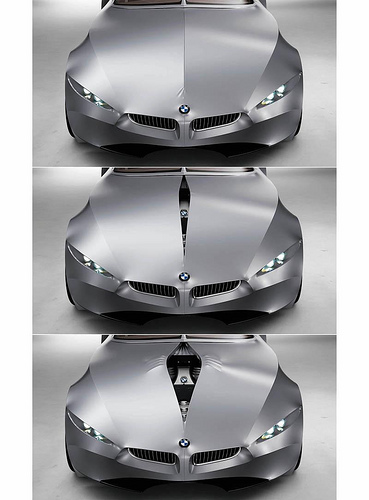
BMW recently revealed the 'GINA', light visionary model concept car, an innovative new exploration in car design. It is a fabric-skinned shape-shifting sports car. Gina stands for "Geometry and functions In 'N' Adaptations". Instead of the traditional steel and plastic body shell, the GINA concept uses a textile fabric starches over a wire frame. This unique idea allows the car’s skin to change shape, stretching to match the position and curve of the wire frame. This idea is demonstrated in the ‘blinking’; headlights and the flexibility of the car doors as they open. The project began by questioning the purpose of a car’s body and exploring new possibilities. Designed by BMW's head of design, Chris Bangle and his team, who says Gina allowed them to 'challenge existing principles and conventional processes. The construction began in 2001.

                                                        BMW Gina, BMW Museum, Munchen, Germany.


Fabric body
The flexible, stretchable, water resistant, translucent, man-made fabric skin – polyurethane-coated Spandex, is resilient and durable. It resists high or low temperatures, does not swell or shrink and the movement does not slacken or damage the fabric. The body changes its shape according to exterior conditions and speeds, and it also allows the driver to change its shape at will. The fabric is stretched over a moveable frame; essential shapes are formed beneath the skin by an aluminium wire structure, though at points where movement is needed (ducts, door openings, spoiler) flexible carbon struts are used. The shape of the frame is controlled by many electric and hydraulic actuators, for example, the headlights are revealed when small motors pull the fabric back in an eyelid like fashion. As the fabric is translucent the taillights shine through it.
Transformations
  • Exterior
GINA has just four panels — the bonnet, the two side panels and the boot. Its skin appears seamless, but it can “grow” a higher rear spoiler for stability at high speed. Its doors open in a butterfly style, and are each covered by a fabric piece reaching all the way from the nose of the car to their trailing edge which when closed leaves a perfectly smooth surface. Access to the engine can be gained through a slit that can open in the middle of the bonnet.


  • Interior
When the car is parked, the car’s steering wheel and instruments sit in an ‘idle’ position on the centre console to allow the driver easy entry. The steering wheel and instruments assume their correct positions when the driver presses the start button and the headrest rises from the seat once the driver is seated, making it easier to get in and out of the car.

November 21, 2011

Top Ten Scientific Breakthroughs of 2010

    Modern age is often referred to as the science age because of the changes, both qualitative and quantitative, brought about by science. In fact in today's world, we cannot think of anything without having a scientific approach to it. Science consists in experimentation, and finding out the mysterious aspects of nature. Every year hundreds of new discoveries are made, but all of them are not included in the list of breakthroughs. Breakthroughs are those discoveries which seem to have qualities that may impact the patterns of thoughts regarding some particular things or principles. Seen from this viewpoint, the top ten breakthroughs of the year 2010 are:
  1. The Quantum Machine
  2. Until March 2010, all man-made objects had moved according to the laws of classical mechanics. Back in March, however, a group of researchers designed a gadget that moves in ways that can only be described by quantum mechanics as the rules that govern the behaviour of tiny things like molecules atoms and subatomic particles. In recognition of the conceptual ground their experiment breaks, the ingenuity behind it and its many potential applications, Science has called this discovery the most significant scientific advance of 2010.
    The quantum machine proves that the principles of quantum mechanics can apply to the motion of macroscopic objects, as well as atomic and subatomic particles. It provides the first key step towards gaining complete control over an object's vibrations at the quantum level. Such control over an engineered device should allow scientists to manipulate those miniscule movements, much to control the quantum states of light, ultra-sensitive force detectors, and ultimately, investigations into the bounds of quantum mechanics and our sense of reality.
  3. Synthetic Biology
  4. In a defining moment for biology and biotechnology, researchers built a synthetic genome and used it to transform the identity of a bacterium. The genome replaced the bacterium's DNA so that it produced a new set of proteins-an achievement that prompted a Congressional hearing on synthetic biology. In the future, researchers envision synthetic genomes that are custom built to generate biofuels, pharmaceuticals and other useful chemicals.
  5. Neanderthal Genome
  6. Researchers sequenced the Neanderthal genome from the bones of three female Neanderthals who lived in Croatia sometime between 38,000 and 44,000 years ago. New methods of sequencing degraded fragments of DNA allowed scientists to make the first direct comparisons between the modern human genome  and that of our Neanderthal ancestors.
  7. HIV Prophylaxis
  8. Two HIV prevention trials of different, novel strategies reported unequivocal success: A vaginal gel, that contains the anti-HIV drug tenofovir, reduced HIV infection in women by 39 percent and an oral pre-exposure prophylaxis led to 43.8 fewer HIV infections in a group of men and transgender women who have sex with men.
  9. Exome Sequencing/Rare Disease Genes
  10. By sequencing just the exons of a genome, or the tiny portion that actually codes for proteins, researchers, who study rare inherited diseases caused by a single flawed gene, were able to identify specific mutations underlying at least a dozen diseases.
  11. Molecular Dynamics Simulations
  12. Simulating the gyrations, that proteins make as they fold, has been a combinatorial nightmare. Now, researchers have harnessed the power of one of the world's most powerful computers to track the motions of atoms in a small, folding protein for a length of 100 times longer than any previous efforts.
  13. Next-Generation Genomics
  14. Faster and cheaper sequencing technologies are enabling very large-scale studies of both ancient and modern DNA. The 1,000 Genomes project, for example, has already indentified much of the genome variation that makes us uniquely human and other projects in the works are set to reveal much more of the genome's functions.
  15. RNA Reprogramming
  16. Reprogramming cells turning back their developmental clocks to make them behave like unspecialized "stem cells" in an embryo has become a standard lab technique for studying diseases and development.
    In 2010, researchers found a way to do it, using synthetic RNA.
  17. Quantum Simulator
  18. To describe what they see in the lab, physicists cook up theories based on equations. Those equations can be fiendishly hard to solve. In 2010, researchers found a short-cut by making quantum simulators artificial crystals in which spots of laser light play the role of ions and atoms trapped in the light stand in for electrons. The devices provide quick answers to theoretical problems in condensed matter physics and they might eventually help solve mysteries such as superconductivity.
  19. The Return of the Rat
  20. Mice rule the world of laboratory animals, but for many purposes, researchers would rather use rats. Rats are easier to work with and anatomically more similar to human beings. A flurry of research in 2010, however promises to bring "knockout rats" to labs in a big way.
    All the scientific breakthroughs help scientific minds to carry on the uphill task of discovering unknown aspects of nature as well as inventing new mechanisms to unravel the mysteries that have been lying partially revealed in nature for ages, creating a lot of confusion. Human civilization never looks back and always tries to step forward in quest of better understanding of the universe, and science becomes a tool in its hands. In other words scientific breakthroughs become part and parcel of our life in course of time and we look forward to others that are to follow.
    Source: Competition Success Review October 2011 Issue