
April 30, 2015
Iceland Creates DNA map of the "Entire Nation"


April 29, 2015
China Plans to build Solar Space Station
 |
| A random space station illustration |
China is planning to build a huge Solar Power Station 36,000 kilometers above the ground in an attempt to solve the increasing energy crisis, greenhouse effects and smog problems.
The power station would be a super spacecraft on a geosynchronous orbit equipped with huge solar panels. The electricity generated would be converted to microwaves or lasers and transmitted to a collector on Earth.
According to Wang Xiji, an academician of the Chinese Academy of Sciences and an International Academy of Astronautics member, the space power station would be really huge, with the total area of the solar panels reaching 5 to 6 sq km. That would be equivalent to 12 of Beijing's Tian'anmen Square, the largest public square in the world, or nearly two New York Central Parks.
The electricity generated from the ground-based solar plants fluctuates with night and day and the weather, but a space generator can collect energy 99 per cent of the time.Also, Space-based solar panels can generate ten times as much electricity as ground-based panels per unit area, says Duan Baoyan, a member of the Chinese Academy of Engineering.
It's also of great strategic significance as whoever gets hold of the technology first could occupy the future energy market. China plans to build this space station by year 2020.
Lamborghini Veneno - Most Expensive Collector's Item

An open racing prototype with an extreme design and breathtaking performance, Lamborghini Veneno is a Limited Production super car based off of the Lamborghini Aventador. Built to celebrate it's 50th anniversary, Lamborghini stated that there are going to be only 9 of Veneno released ever. One of these cars, dubbed Car Zero, is to be placed in Lamborghini's Museum as display vehicle.
April 28, 2015
Bloodborne Game Review

Warning: Bloodborne is quite difficult, very playable, but does not dumb down the action. You will die a lot, however, that is one of the best parts of the game. Read on to find out more...
April 27, 2015
Aston Martin DB11 Concept Car

A3W Motiv Concept MotorBike

French designer Julien Rondino’s three-wheeled motorcycle concept – the A3W Motiv.
We are waiting for more details on the bike. But for now, what we know is that the bike has been designed around KTM’s 999cc LC8 v-twin. The chassis seems to be a mix of cast aluminium and steel tube sections and the bike is packed with interesting bits – hub-centre steering, adjustable ergonomics and Buell-style perimeter brakes.
Here is the Link to an album of A3W Motiv's Pics.
April 26, 2015
Acura NSX comes up with really cool info...

At the Society of Automotive Engineers 2015
World Congress, Acura spilled some new details about the upcoming
next-generation NSX. Befitting the audience, it was all very
techno-nerdy.
April 24, 2015
The Suzuki Crosscage Concept MotorBike
 |
| Suzuki Crosscage Concept |
April 23, 2015
Chevy's Robo-Car Concept is Switchblade on wheels
 |
| The Chevrolet-FNR is unlike any self-driven car or concept we've ever seen. |
GENERAL MOTORS HAS a vision of motoring in 2030, when autonomous cars free us from the tyranny of the commute, and it’s … interesting.
August 18, 2013
Deep Learning
 |
| Deep Learning |
When Ray Kurzweil met with Google CEO Larry Page last July, he wasn’t looking for a job. A respected inventor who’s become a machine-intelligence futurist, Kurzweil wanted to discuss his upcoming book How to Create a Mind. He told Page, who had read an early draft, that he wanted to start a company to develop his ideas about how to build a truly intelligent computer: one that could understand language and then make inferences and decisions on its own.
It quickly became obvious that such an effort would require nothing less than Google-scale data and computing power. “I could try to give you some access to it,” Page told Kurzweil. “But it’s going to be very difficult to do that for an independent company.” So Page suggested that Kurzweil, who had never held a job anywhere but his own companies, join Google instead. It didn’t take Kurzweil long to make up his mind: in January he started working for Google as a director of engineering. “This is the culmination of literally 50 years of my focus on artificial intelligence,” he says.
Kurzweil was attracted not just by Google’s computing resources but also by the startling progress the company has made in a branch of AI called deep learning. Deep-learning software attempts to mimic the activity in layers of neurons in the neocortex, the wrinkly 80 percent of the brain where thinking occurs. The software learns, in a very real sense, to recognize patterns in digital representations of sounds, images, and other data.
The basic idea—that software can simulate the neocortex’s large array of neurons in an artificial “neural network”—is decades old, and it has led to as many disappointments as breakthroughs. But because of improvements in mathematical formulas and increasingly powerful computers, computer scientists can now model many more layers of virtual neurons than ever before.
With this greater depth, they are producing remarkable advances in speech and image recognition. Last June, a Google deep-learning system that had been shown 10 million images from YouTube videos proved almost twice as good as any previous image recognition effort at identifying objects such as cats. Google also used the technology to cut the error rate on speech recognition in its latest Android mobile software. In October, Microsoft chief research officer Rick Rashid wowed attendees at a lecture in China with a demonstration of speech software that transcribed his spoken words into English text with an error rate of 7 percent, translated them into Chinese-language text, and then simulated his own voice uttering them in Mandarin. That same month, a team of three graduate students and two professors won a contest held by Merck to identify molecules that could lead to new drugs. The group used deep learning to zero in on the molecules most likely to bind to their targets.
Google in particular has become a magnet for deep learning and related AI talent. In March the company bought a startup cofounded by Geoffrey Hinton, a University of Toronto computer science professor who was part of the team that won the Merck contest. Hinton, who will split his time between the university and Google, says he plans to “take ideas out of this field and apply them to real problems” such as image recognition, search, and natural-language understanding, he says.
All this has normally cautious AI researchers hopeful that intelligent machines may finally escape the pages of science fiction. Indeed, machine intelligence is starting to transform everything from communications and computing to medicine, manufacturing, and transportation. The possibilities are apparent in IBM’s Jeopardy!-winning Watson computer, which uses some deep-learning techniques and is now being trained to help doctors make better decisions. Microsoft has deployed deep learning in its Windows Phone and Bing voice search.
Extending deep learning into applications beyond speech and image recognition will require more conceptual and software breakthroughs, not to mention many more advances in processing power. And we probably won’t see machines we all agree can think for themselves for years, perhaps decades—if ever. But for now, says Peter Lee, head of Microsoft Research USA, “deep learning has reignited some of the grand challenges in artificial intelligence.”
Building a Brain
There have been many competing approaches to those challenges. One has been to feed computers with information and rules about the world, which required programmers to laboriously write software that is familiar with the attributes of, say, an edge or a sound. That took lots of time and still left the systems unable to deal with ambiguous data; they were limited to narrow, controlled applications such as phone menu systems that ask you to make queries by saying specific words.
Neural networks, developed in the 1950s not long after the dawn of AI research, looked promising because they attempted to simulate the way the brain worked, though in greatly simplified form. A program maps out a set of virtual neurons and then assigns random numerical values, or “weights,” to connections between them. These weights determine how each simulated neuron responds—with a mathematical output between 0 and 1—to a digitized feature such as an edge or a shade of blue in an image, or a particular energy level at one frequency in a phoneme, the individual unit of sound in spoken syllables.
Some of today’s artificial neural networks can train themselves to recognize complex patterns.
Programmers would train a neural network to detect an object or phoneme by blitzing the network with digitized versions of images containing those objects or sound waves containing those phonemes. If the network didn’t accurately recognize a particular pattern, an algorithm would adjust the weights. The eventual goal of this training was to get the network to consistently recognize the patterns in speech or sets of images that we humans know as, say, the phoneme “d” or the image of a dog. This is much the same way a child learns what a dog is by noticing the details of head shape, behavior, and the like in furry, barking animals that other people call dogs.
But early neural networks could simulate only a very limited number of neurons at once, so they could not recognize patterns of great complexity. They languished through the 1970s.

WHY IT MATTERS
Computers would assist humans far more effectively if they could reliably recognize patterns and make inferences about the world.Breakthrough
A method of artificial intelligence that could be generalizable to many kinds of applications.
Key Players
• Microsoft
• IBM
• Geoffrey Hinton, University of Toronto

August 17, 2013
Smart Watches
 |
| Pebble Smart Watches |
Eric Migicovsky didn’t really want a “wearable computer.” When he first conceived of what would become the Pebble smart watch five years ago, as an industrial-design student at Delft University of Technology in the Netherlands, he just wanted a way to use his smartphone without crashing his bicycle. “I thought of creating a watch that could grab information from my phone,” the 26-year-old Canadian says. “I ended up building a prototype in my dorm room.”
Now Migicovsky is shipping 85,000 Pebble watches to eager customers who don’t want to lug a glass slab out of their pocket just to check their e-mail or the weather forecast. Pebble uses Bluetooth to connect wirelessly to an iPhone or Android phone and displays notifications, messages, and other simple data of the user’s choosing on its small black-and-white LCD screen. In April 2012, using the online fund-raising platform Kickstarter, Migicovsky asked for $100,000 to help bring Pebble to market. Five weeks later, he had more than $10 million—making his the highest-grossing Kickstarter campaign yet. Suddenly smart watches are a real product category: Sony entered the market last year,Samsung is about to, and Apple seems likely to follow.
Although the $150 Pebble watch can be used to control a music playlist or run simple apps like RunKeeper, a cloud-based fitness tracker, Migicovsky and his team purposely designed the watch to do as little as possible, leaving more complicated apps for phones. This emphasis on making the watch “glanceable” informed nearly every aspect of the design. The black-and-white screen, for example, can be read in direct sunlight and displays content persistently without needing to “sleep” to conserve battery power, as color or touch-screen displays do.
These watches are coming to market a few months before Google Glass, which is another attempt to solve the problem Pebble addresses—namely, that “interacting with our phones has a certain overhead that doesn’t need to be there,” says Mark Rolston, chief creative officer of Frog Design. But Google Glass will try to replace the smartphone altogether by combining a computer and monitor into eyeglass frames so that wearers can “augment” their view of the world with data. That lines up with predictions about the advent of wearable computing, but it’s easy to see Pebble’s idea being much more popular. By making use of a watch—a classic accessory—Pebble is trying to fit in to long-standing social norms rather than create new ones.
Why It Matters
Even as computing gets more sophisticated, people want simple and easy-to-use interfaces.Breakthrough
Watches that pull selected data from mobile phones so their wearers can absorb information with a mere glance.
Key Players
• Pebble
• Sony
• Motorola
• MetaWatch
August 10, 2013
Ultra-Efficient Solar Power
Harry Atwater thinks his lab can make an affordable
device that produces more than twice the solar power generated by
today’s panels. The feat is possible, says the Caltech professor of
materials science and applied physics, because of recent advances in the
ability to manipulate light at a very small scale.
Atwater’s team is working on three designs. In one (see illustration), for which the group has made a prototype, sunlight is collected by a reflective metal trough and directed at a specific angle into a structure made of a transparent insulating material. Coating the outside of the transparent structure are multiple solar cells, each made from one of six to eight different semiconductors. Once light enters the material, it encounters a series of thin optical filters. Each one allows a single color to pass through to illuminate a cell that can absorb it; the remaining colors are reflected toward other filters designed to let them through.
 |
| Solar Power Grid |
Another design would employ nanoscale optical filters that could filter light coming from all angles. And a third would use a hologram instead of filters to split the spectrum. While the designs are different, the basic idea is the same: combine conventionally designed cells with optical techniques to efficiently harness sunlight’s broad spectrum and waste much less of its energy.
It’s not yet clear which design will offer the best performance, says Atwater. But the devices envisioned would be less complex than many electronics on the market today, he says, which makes him confident that once a compelling prototype is fabricated and optimized, it could be commercialized in a practical way.
Achieving ultrahigh efficiency in solar designs should be a primary goal of the industry, argues Atwater, since it’s now “the best lever we have” for reducing the cost of solar power. That’s because prices for solar panels have plummeted over the past few years, so continuing to focus on making them less expensive would have little impact on the overall cost of a solar power system; expenses related to things like wiring, land, permitting, and labor now make up the vast majority of that cost. Making modules more efficient would mean that fewer panels would be needed to produce the same amount of power, so the costs of hardware and installation could be greatly reduced. “Within a few years,” Atwater says, “there won’t be any point to working on technology that has efficiency that’s less than 20 percent.”
Why It Matters
Higher efficiency would make solar power more competitive with fossil fuels.
Breakthrough
Managing light to harness more of sunlight’s energy.
Key Players
• Harry Atwater, Caltech
• Albert Polman, AMOLF
• Eli Yablonovitch,
University of
California, Berkeley
• Dow Chemical
August 3, 2013
Memory Implants

Berger and his research partners have yet to conduct human tests of their neural prostheses, but their experiments show how a silicon chip externally connected to rat and monkey brains by electrodes can process information just like actual neurons. “We’re not putting individual memories back into the brain,” he says. “We’re putting in the capacity to generate memories.” In an impressive experiment published last fall, Berger and his coworkers demonstrated that they could also help monkeys retrieve long-term memories from a part of the brain that stores them.
If a memory implant sounds farfetched, Berger points to other recent successes in neuroprosthetics. Cochlear implants now help more than 200,000 deaf people hear by converting sound into electrical signals and sending them to the auditory nerve. Meanwhile, early experiments have shown that implanted electrodes can allow paralyzed people to move robotic arms with their thoughts. Other researchers have had preliminary success with artificial retinas in blind people.
Still, restoring a form of cognition in the brain is far more difficult than any of those achievements. Berger has spent much of the past 35 years trying to understand fundamental questions about the behavior of neurons in the hippocampus, a part of the brain known to be involved in forming memory. “It’s very clear,” he says. “The hippocampus makes short-term memories into long-term memories.”
What has been anything but clear is how the hippocampus accomplishes this complicated feat. Berger has developed mathematical theorems that describe how electrical signals move through the neurons of the hippocampus to form a long-term memory, and he has proved that his equations match reality. “You don’t have to do everything the brain does, but can you mimic at least some of the things the real brain does?” he asks. “Can you model it and put it into a device? Can you get that device to work in any brain? It’s those three things that lead people to think I’m crazy. They just think it’s too hard.”
Cracking the Code
Berger often speaks in sentences that stretch to paragraph length and have many asides, footnotes, and complete diversions from the point. I ask him to define memory. “It’s a series of electrical pulses over time that are generated by a given number of neurons,” he says. “That’s important because you can reduce it to this and put it back into a framework. Not only can you understand it in terms of the biological events that happened; that means that you can poke it, you can deal with it, you can put an electrode in there, and you can record something that matches your definition of a memory. You can find the 2,147 neurons that are part of this memory. And what do they generate? They generate this series of pulses. It’s not bizarre. It’s something you can handle. It’s useful. It’s what happens.”
This is the conventional view of memory, but it only scratches the surface. And to Berger’s perpetual frustration, many colleagues who probe this mysterious realm of the brain haven’t attempted to go much deeper. Neuroscientists track electrical signals in the brain by monitoring action potentials, microvolt changes on the surfaces of neurons. But all too often, says Berger, their reports oversimplify what’s actually taking place. “They find an important event in the environment and count action potentials,” he says. “They say, ‘It went up from 1 to 200 after I did something. I’m finding something interesting.’ What are you finding? ‘Activity went up.’ But what are you finding? ‘Activity went up.’ So what? Is it coding something? Is it representing something that the next neuron cares about? Does it make the next neuron do something different? That’s what we’re supposed to be doing: explaining things, not just describing things.”
If one neuron fires at a specific time and place, what exactly do the neighboring neurons do in response?
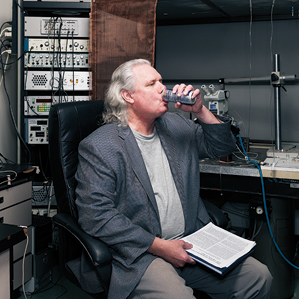 Berger takes a marker and fills a whiteboard from top to bottom with a
line of circles that represent neurons. Next to each one, he draws a
horizontal line that has a different pattern of blips on it. “This is
you in my brain,” he says. “My hippocampus has already formed a
long-term memory of you. I’ll remember you into next week. But how can I
distinguish you from the next person? Let’s say there are 500,000 cells
in the hippocampus that represent you, and there are all sorts of
things that each cell is coding—like how your nose is relative to your
eyebrow—and they code that with different patterns. So the reality of
the nervous system is really complicated, which is why we’re still
asking such basic, limited questions about it.”
Berger takes a marker and fills a whiteboard from top to bottom with a
line of circles that represent neurons. Next to each one, he draws a
horizontal line that has a different pattern of blips on it. “This is
you in my brain,” he says. “My hippocampus has already formed a
long-term memory of you. I’ll remember you into next week. But how can I
distinguish you from the next person? Let’s say there are 500,000 cells
in the hippocampus that represent you, and there are all sorts of
things that each cell is coding—like how your nose is relative to your
eyebrow—and they code that with different patterns. So the reality of
the nervous system is really complicated, which is why we’re still
asking such basic, limited questions about it.”Theodore Berger has spent his career trying to understand how neurons form memories.
In graduate school at Harvard, Berger’s mentor was Richard Thompson, who studied localized, learning-induced changes in the brain. Thompson used a tone and a puff of air to condition rabbits to blink their eyes, aiming to determine where the memory he induced was stored. The idea was to find a specific place in the brain where the learning was localized, says Berger: “If the animal did learn and you removed it, the animal couldn’t remember.”
Thompson, with Berger’s help, managed to do just that; they published the results in 1976. To find the site in the rabbits, they equipped the animals’ brains with electrodes that could monitor the activity of a neuron. Neurons have gates on their membranes, which let electrically charged particles like sodium and potassium in and out. Thompson and Berger documented the electrical spikes seen in the hippocampus as rabbits developed a memory. Both the spikes’ amplitude (representing the action potential) and their spacing formed patterns. It can’t be an accident, Berger thought, that cells fire in a way that forms patterns with respect to time.
This led him to a central question that underlies his current work: as cells receive and send electrical signals, what pattern describes the quantitative relationship between the input and the output? That is, if one neuron fires at a specific time and place, what exactly do the neighboring neurons do in response? The answer could reveal the code that neurons use to form a long-term memory.
But it soon became clear that the answer was extremely complex. In the late 1980s, Berger, working at the University of Pittsburgh with Robert Sclabassi, became fascinated by a property of the neuronal network in the hippocampus. When they stimulated the hippocampus of a rabbit with electrical pulses (the input) and charted how signals moved through different populations of neurons (the output), the relationship they observed between the two wasn’t linear. “Let’s say you put in 1 and get 2,” says Berger. “That’s pretty easy. It’s a linear relation.” It turns out, however, that there’s “essentially no condition in the brain where you get linear activity, a linear summation,” he says. “It’s always nonlinear.” Signals overlap, with some suppressing an incoming pulse and some accentuating it.
By the early 1990s, his understanding—and computing hardware—had advanced to the point that he could work with his colleagues at the University of Southern California’s department of engineering to make computer chips that mimic the signal processing done in parts of the hippocampus. “It became obvious that if I could get this stuff to work in large numbers in hardware, you’ve got part of the brain,” he says. “Why not hook up to what’s existing in the brain? So I started thinking seriously about prosthetics long before anybody even considered it.”
A Brain Implant
Berger began working with Vasilis Marmarelis, a biomedical engineer at USC, to begin making a brain prosthesis (see “Regaining Lost Brain Function”). They first worked with hippocampal slices from rats. Knowing that neuronal signals move from one end of the hippocampus to the other, the researchers sent random pulses into the hippocampus, recorded the signals at various locales to see how they were transformed, and then derived mathematical equations describing the transformations. They implemented those equations in computer chips.
Next, to assess whether such a chip could serve as a prosthesis for a damage hippocampal region, the researchers investigated whether they could bypass a central component of the pathway in the brain slices. Electrodes placed in the region carried electrical pulses to an external chip, which performed the transformations normally done in the hippocampus. Other electrodes delivered the signals back to the slice of brain.
“I never thought I’d see this go into humans, and now our discussions are about when and how. I never thought I’d live to see the day.”Then the researchers took a leap forward by trying this in live rats, showing that a computer could in fact serve as an artificial component of the hippocampus. They began by training the animals to push one of two levers to receive a treat, recording the series of pulses in the hippocampus as they chose the correct one. Using those data, Berger and his team modeled the way the signals were transformed as the lesson was converted into a long-term memory, and they captured the code believed to represent the memory itself. They proved that their device could generate this long-term memory code from input signals recorded in rats’ brains while they learned the task. Then they gave the rats a drug that interfered with their ability to form long-term memories, causing them to forget which lever produced the treat. When the researchers pulsed the drugged rats’ brains with the code, the animals were again able to choose the right lever.
Last year, the scientists published primate experiments involving the prefrontal cortex, a part of the brain that retrieves the long-term memories created by the hippocampus. They placed electrodes in the monkey brains to capture the code formed in the prefrontal cortex that they believed allowed the animals to remember an image they had been shown earlier. Then they drugged the monkeys with cocaine, which impairs that part of the brain. Using the implanted electrodes to send the correct code to the monkeys’ prefrontal cortex, the researchers significantly improved the animal’s performance on the image-identification task.
Within the next two years, Berger and his colleagues hope to implant an actual memory prosthesis in animals. They also want to show that their hippocampal chips can form long-term memories in many different behavioral situations. These chips, after all, rely on mathematical equations derived from the researchers’ own experiments. It could be that the researchers were simply figuring out the codes associated with those specific tasks. What if these codes are not generalizable, and different inputs are processed in various ways? In other words, it is possible that they haven’t cracked the code but have merely deciphered a few simple messages.
Berger allows that this may well be the case, and his chips may form long-term memories in only a limited number of situations. But he notes that the morphology and biophysics of the brain constrain what it can do: in practice, there are only so many ways that electrical signals in the hippocampus can be transformed. “I do think we’re going to find a model that’s pretty good for a lot of conditions and maybe most conditions,” he says. “The goal is to improve the quality of life for somebody who has a severe memory deficit. If I can give them the ability to form new long-term memories for half the conditions that most people live in, I’ll be happy as hell, and so will be most patients.”
Despite the uncertainties, Berger and his colleagues are planning human studies. He is collaborating with clinicians at his university who are testing the use of electrodes implanted on each side of the hippocampus to detect and prevent seizures in patients with severe epilepsy. If the project moves forward as envisioned, Berger’s group will piggyback on the trial to look for memory codes in those patients’ brains.
“I never thought I’d see this go into humans, and now our discussions are about when and how,” he says. “I never thought I’d live to see the day, but now I think I will.”
WHY IT MATTERS
Brain damage can cause people to lose the ability to form long-term memories.Breakthrough
Animal experiments show it is possible to correct for memory problems with implanted electrodes.
Key Players
• Theodore Berger, USC
• Sam Deadwyler, Wake Forest
• Greg Gerhardt,
University of Kentucky
• DARPA
August 3, 2012
Asymmetry in nature: The story of our existence
We have seen
symmetry everywhere around us. We say everything that is good has something bad
too. If we approach this symmetry from Physics point of view, there are
electrons and opposing them are protons, then there are neutral particles
called neutrons. These three particles are responsible for everything around
us, everything we call matter.
But as I have learned, matter and anti-matter is always created together. And keeping the symmetry, matter and anti-matter must have been in equal amounts . We see matter, so where is this anti-matter?
Well of-course the answer lies in the universe outside our earth. As we have seen from Hubble telescope, all the galaxies around us are moving away from us. That means that our universe is expanding. This conclusion gave birth to a new theory, the only one that explains the violent start of the universe and its expansion. And according to this theory, everything must have been at the same place, all galaxies and stars collected together between some 10-15 billion years ago.
But as I have learned, matter and anti-matter is always created together. And keeping the symmetry, matter and anti-matter must have been in equal amounts . We see matter, so where is this anti-matter?
Well of-course the answer lies in the universe outside our earth. As we have seen from Hubble telescope, all the galaxies around us are moving away from us. That means that our universe is expanding. This conclusion gave birth to a new theory, the only one that explains the violent start of the universe and its expansion. And according to this theory, everything must have been at the same place, all galaxies and stars collected together between some 10-15 billion years ago.
Do you remember
Einstein's mass-energy equation, E = mc². That equation is a fact, and another
fact is that the matter and anti-matter were created together. These two facts
taken together implies that ten-billionths of a second just after the Bing
bang, the entire Universe would have fitted into a single room, where energy
and matter were completely exchangeable - temperature, billions of billions of
billions degrees. New particles and anti-particles were created all the time
and annihilated back into energy.
So where did these
antiparticles go? There should have been equal amounts of matter and
anti-matter. But somehow, scientists could not understand why, a small surplus
of matter appeared; for every billion anti-matter particles, there were a
billion plus one matter particles. Nature created very little asymmetry, which
gave birth to all of the universe. This asymmetry gave a kick to the Universe
which tipped to the 'matter side'. And as matter increased, within a second the
whole of the anti-matter part of Universe was destroyed to nothing. While
expanding the temperature continuously dropped till it reached a point where no
more particles and anti-particles can be created and all that left was a little
amount of matter, which we see as our Universe.
Does that mean, we
owe our existence to a little asymmetry between matter and anti-matter? Yes,
without that asymmetry, there would have been no universe, no earth, no humans.
Universe would have been nothing but light in an empty space.

July 28, 2012
Ford Classic in India
Ford India has launched the new Ford Classic Titanium version of the Ford Classic sedan car (earlier was known as Fiesta Classic) . The unique feature of this model is up to 34.38 km/L mileage (diesel) which is leaps higher than what other diesel sedan cars offer .

Ford Classic Petrol
- Ford Classic 1.6 Duratec LXi
- Ford Classic 1.6 Duratec CLXi
- Ford Classic 1.6 Duratec Titanium
Ford Classic Diesel
- Ford Classic 1.4 TDCi LXi
- Ford Classic 1.4 TDCi CLXi
- Ford Classic 1.4 TDCi Titanium
specifications :
- Physical specs
- Dimensions : 4282x1686x1468 mm
- Wheel Base : 2486 mm
- Ground clearance : 168 mm
- Kerb weight : 1150 kg
- Turning radius : 4.90 m
- Fuel Tank Capacity : 45 L
- Boot space : 430 L
- Engine
- Diesel Engine
- Type : 4 Cyl. In-Line, 8-V SOHC
- Construction : Aluminium Alloy
- Fuel system : Advanced Common Rail
- Displacement : 1399 cc
- Compression Ratio : 18:1
- Max. power : 68 ps @ 4000 RPM
- Max. torque : 160 Nm @ 2000 RPM
- Petrol Engine
- Type : 4 Cyl. In-Line, 16-V DOHC
- Construction : Aluminium Alloy
- Fuel system : SEFI
- Displacement : 1596 cc
- Compression Ratio : 9.75:1
- Max. power : 101 ps @ 6500 RPM
- Max. torque : 146 Nm @ 3400 RPM
- Suspension
- Front : Independent McPherson struts with offset coil spring
- Rear : Semi-independent heavy duty twist-beam with twin tube dampers
- Shock absorbers : Gas Filled
- Brakes
- Front : Ventilated Discs
- Rear : Self Adjusting Drums
- Tyres
- Tyres : 175/65 R14
- Wheel Size : 14-inch Alloy (in Titanium version only)


Ford Classic Price in India
Ford Classic Petrol Price in Delhi
- Ford Classic 1.6 Duratec LXi – Rs.5,27,000
- Ford Classic 1.6 Duratec CLXi – Rs.5,49,000
- Ford Classic 1.6 Duratec Titanium – Rs.6,86,500
- Ford Classic 1.6 Duratec SXi – Rs.7,29,000
Ford Classic Diesel Price in Delhi
- Ford Classic 1.4 TDCi LXi – Rs.6,57,000
- Ford Classic 1.4 TDCi CLXi – Rs.6,98,000
- Ford Classic 1.4 TDCi Titanium – Rs.7,82,900
- Ford Classic 1.4 TDCi SXi – Rs.8,19,000
July 26, 2012
Audi R8 2013
Audi has made its R8
high-performance sports car even more attractive and dynamic. The Audi R8 V10
plus is a new top model in the model series, with a totally new 7-speed S
tronic. The LED headlights and the new rear indicator lights with dynamicized
display are standard equipment on all variants.

4.44 meters (14.44
ft) long, 1.90 meters (6.23 ft) wide and only 1.25 (4.10 ft) meters high
(Spyder: 1.24 meters (4.07 ft)) - the broad Audi R8, developed and built by
quattro GmbH, stands firmly on the road, ready to pounce. New details lend its
design even more acuity. The single-frame grille with the beveled upper corners
is painted high-gloss black, with horizontal chrome inserts adorning the struts
on the V10 variants. The bumper is also new, with the air inlets bearing three
crossbars each. As an option, Audi installs a front splitter made of carbon
fiber reinforced plastic (CFRP). The splitter is standard on the new Audi R8
V10 plus.
LED headlights with
a new technology are now standard on all variants of the Audi R8. The
light-emitting diodes for the high and low beams have been placed above and
below the strip-shaped daytime running lights, which are specially actuated to
serve as indicators. In addition, static turning lights are integrated in the
headlights.
The housings of the
outside mirrors and the side blades, the lateral air inlets on the Coupé, are
made from CFRP on the new Audi R8 V10 plus top model. In the 10-cylinder
variants the blades extend outwards farther than on the V8 and have special
edging; small marks of distinction also occur at the sills. The vent louvers
next to the rear window have an aluminum look on the Audi R8 V10 Coupé (matt
black on the R8 V8 Coupé and R8 V10 plus). As an option, LEDs illuminate the
engine compartment; in the Audi R8 V10 plus this illumination as well as a
partial CFRP lining for the engine compartment are standard.
The LED lights
dominate the rear of the Audi R8. One innovation from Audi is the indicator
light with dynamic display at the bottom edge of the lamp - its light always
proceeds towards the outside, in the direction the driver wishes to turn. Above
the high-gloss black area between the vent openings sits the new badge - the
letter "R" resting partly on a red diamond, the Audi Sport signature.
The large diffusor, optionally CFRP (standard on the R8 V10 plus), has been
pulled far upwards. In all engine versions the exhaust system terminates in two
round, glossy tailpipe trim sections, painted black on the Audi R8 V10 plus.
Audi offers the R8
in the two solid colors Ibis White and Brilliant Red, in four metallic shades
and with five pearl effect / crystal effect coatings. For the Audi R8 V10 plus
a matt effect color is available as an exclusive feature. The side blades on the
Coupé come in eight colors, while the soft top of the R8 Spyder comes in black,
red or brown.

The R8 embodies
Audi's full expertise in ultra-lightweight design. The aluminum body with the
Audi Space Frame (ASF) weighs only 210 kilograms (462.97 lb) on the Coupé, and
216 kilograms (476.20 lb) on the Spyder. The unladen Audi R8 V8 Coupé with
manual transmission registers just 1,560 kilograms (3439.21 lb) on the scales,
while the open-top sports car weighs 1,660 kilograms (3659.67 lb). The Audi R8
V10 plus, available only as a coupé, brings the needle to 1,570 kilograms
(3461.26 lb). Adjustable bucket seats with glass fiber reinforced plastic
(GFRP) chassis, less use of insulating materials, special light alloy wheels
and chassis components, including the standard ceramic brakes, as well the CFRP
add-on parts at the body all contribute to lowering the weight.
On the Audi R8
Spyder the lid on the soft top compartment and the side parts are also CFRP.
The elegant, lightweight fabric top, with its largely aluminum and magnesium
linkage, is the crowning touch to the ultra-lightweight design. The top opens
and closes electrohydraulically in 19 seconds, and during driving at up to 50
km/h (31.07 mph). The heated window pane in the bulkhead between the passenger
and engine compartments stands apart from the soft top; the window can be
retracted and extended by a switch and also serves as a wind deflector. In case
of a pending rollover, two strong, spring-tensioned sections shoot upwards from
the seats.

As in car racing,
the aerodynamics of the Audi R8 has been optimized for propulsion. The
underfloor contains five NACA nozzles, along with two diffusors in the front
section, which increase the propulsion at the front axle. The drag coefficient
is 0.35 or 0.36 depending on the engine version and body shape; the frontal
area measures 1.99 m2 (21.42 ft2).
The engines are
assembled by hand. The V8 with 4,163 cc displacement and the V10 with its 5,204
cc displacement are captivating, naturally aspirated heavy-duty engines packed
with power. The interplay with the new 7-speed S tronic has reduced CO2 emissions
by up to 22 grams/km (35.41 g/mile) and decreased the sprint from zero to 100
km/h (62.14 mph) by three-tenths of a second. Both engines are compact and
comparatively lightweight. The crankcase is an aluminum-silicon alloy; the bed
plate structure provides high rigidity. The dry-sump lubrication allows low
positioning of the engines; the pressure recirculation pump operates
load-dependently, for increased efficiency.

The 4.2 FSI engine
produces 316 kW (430 hp) at 7,900 rpm, with a torque of 430 Nm (317.15 lb-ft)
between 4,500 and 6,000 rpm. The unit accelerates the Audi R8 Coupé with S
tronic from rest to 100 km/h (62.14 mph) in 4.3 seconds and to a top speed of
300 km/h (186.41 mph) (with manual transmission: 4.6 seconds and 302 km/h
(187.65 mph)). For the Audi R8 V8 Spyder the corresponding values are 4.5 and
4.8 seconds, respectively, and also 300 km/h (186.41 mph). On average the R8 V8
quattro as a coupé with S tronic consumes 12.4 liters of fuel per 100 km (18.97
US mpg).
The V10 engine
provides a torque of 530 Nm (390.91 lb-ft) at 6,500 rpm, with 386 kW (525 hp)
at 8,000 rpm. Its crankshaft is a common-pin design, yielding alternating
ignition intervals of 54 and 90 degrees. This design combines maximum rigidity
and low weight, while at the same time generating the unique car racing-like
sound of the V10.
The Audi R8 V10
Coupé with S tronic accelerates from zero to 100 km/h (62.14 mph) in 3.6
seconds and reaches a top speed of 314 km/h (195.11 mph). With manual
transmission the values are 3.9 seconds and 316 km/h (196.35 mph). The Audi R8
V10 Spyder with S tronic completes the standard sprint in 3.8 seconds and has a
top speed of 311 km/h (193.25 mph) (with manual transmission: 4.1 seconds and
313 km/h (194.49 mph)). The average consumption rate of the Audi R8 V10 Coupé
with S tronic lies at 13.1 liters of fuel per 100 km (17.96 US mpg).
The new top model of
the model series is the Audi R8 V10 plus. Developing 404 kW (550 hp), its
maximum torque is 540 Nm (398.28 lb-ft) at 6,500 rpm. With S tronic, the Audi
R8 V10 plus, available only as a coupé, catapults from zero to 100 km/h (62.14
mph) in 3.5 seconds and achieves a top speed of 317 km/h (196.97 mph); the
average fuel consumption rate is 12.9 liters per 100 km (18.23 US mpg). The key
data with manual transmission are 3.8 seconds, 319 km/h (198.22 mph) and 14.9
liters (15.79 US mpg).

Two power
transmission systems are available for the overhauled Audi R8. The manual
6-speed transmission, with its lever leading into an open stainless steel gate,
is standard on the V8 and optional on the V10. The new 7-speed S tronic -
optional on the V8 and standard on the V10 - spaces the gears closely in a
sporty mode; the final drive position has a wide gear ratio. The dual clutch
transmission can be shifted at the selector lever or at the steering wheel
paddles; a sports mode is alternatively available. At the press of a button the
launch control manages starting at an increased initial engine speed and with
optimal tire slip.
The new 7-speed S
tronic, with a three-shaft layout, is less than 60 centimeters (23.62 inches)
in length. Two multi-plate clutches lying behind one another (a new feature),
serve two mutually independent sub-transmissions; gears are shifted directly as
the clutches alternately open and close. Gearshifting occurs practically
without interruption of tractive power within hundredths of a second, and so
dynamically, smoothly and comfortably as to be hardly noticeable.
From the 7-speed S
tronic the propeller shaft runs through the crankcase of the engine to the
front axle, where a viscous coupling distributes the torque. In normal
operation the coupling directs about 15 per cent of the torque to the front
axle; when the rear wheels start to spin, a maximum additional 15 per cent
flows to the front. A mechanical locking differential operates at the rear
axle. The rear-load distribution of the forces ideally harmonizes with the
mid-engined concept of the Audi R8. The axle-load distribution is 43 : 57
(front : rear), with small differences between the individual variants.
The chassis of the
high-performance sports car employs technologies from car racing. Double
wishbones forged from aluminum guide all four wheels. On the R8 V10 plus the
springs and shock absorbers have been specially tuned and the camber values at
the front axle adapted accordingly. The Audi magnetic ride adaptive damping is
standard on the Audi R8 V10 and optional for the V8 variants; it offers a
normal mode and a sports mode. The power steering delivers finely
differentiated, super-sensitive feedback, with sporty, direct gear ratios.
The overhauled R8
rolls along on large wheels. The V8 engine versions have the standard wheel
dimensions of 8.5 J x 18 at the front and 10.5 J x 18 at the rear, with tire
sizes 235/40 and 285/35. On the V10 versions Audi mounts 19-inch wheels of
widths 8.5 and 11 inches; the tires come in the sizes 235/35 and 295/30
respectively. The optional wheels have especially attractive designs - polished
to a high gloss, with a titanium look or (on the R8 V10 plus) in black gloss.
The steel brake
disks of the high-performance sports car are internally ventilated, perforated
and joined to the aluminum disk bowls by pins. The new "Wave" design
of the disks - the wavy exterior contour - lowers the weight overall by about
two kilograms (4.41 lb) compared with round disks of the same dimensions. The
aluminum brake calipers operate at the front wheels with eight pistons each,
and at the rear wheels with four pistons each. In combination with the 19-inch
wheels, Audi can provide optional carbon fiber ceramic brake disks (standard on
the Audi R8 V10 plus). The electronic stabilization control system ESC offers a
sports mode and can also be fully deactivated.

The Audi R8 is a
sports car with excellent practical skills. The front luggage compartment has a
capacity of 100 liters (3.53 cubic ft); the Coupé accommodates an additional 90
liters (3.18 cubic ft) behind the seats. The long wheelbase of 2.65 meters (8.69
cubic ft) affords generous space. The interior conveys a car racing atmosphere
on the luxury level; its dominant feature is the monoposto - the long arc curve
running around the cockpit in the area of the driver. The flattened rim of the
optional, more contoured R8 leather-covered multifunction sports steering wheel
bears the new R8 badge, which also appears at the gearshift or selector lever,
at the door sill trims, in the instrument cluster and on the start screen of
the on-board monitor.
The electrically
adjustable sports seats are optional on the V8 engine versions and standard on
the V10 variants. Depending on the model variant, the seat upholstery is an
Alcantara/leather combination or Fine Nappa; on the Audi R8 Spyder a special
pigmentation reduces heating from direct sunlight. Audi also offers optional
bucket seats with prominent side sections for better lateral support (standard
on the R8 V10 plus).
Numerous control and
trim elements shine with subdued chrome strips or with black paint; the needles
in the instrument cluster and the shift paddles have been slightly modified.
The center console and the handbrake lever are covered with leather, adorned by
delicate seams; in the V10 models the molding around the standard navigation
system plus is also leather-covered.
With the
diamond-stitched, Fine Nappa full-leather equipment level, the seats and the
door trim feature quilted upholstery; for the Audi R8 Coupé a quilted Alcantara
headlining is also available. More individualistic customers can choose between
leather items in different colors, inlays in Carbon Sigma (standard on the R8
V10 plus) and piano finish black. A wide range of design, styling and leather
packages from the Audi exclusive customization line is also available.

The Audi R8 V10 and
the R8 V10 plus come with the navigation system plus and the Bang & Olufsen
Sound System as standard on-board features. Other options for all R8 variants
include a high-beam assistant, a stowage package, various travel case sets, a
cell phone preparation, with belt microphone and voice control, and the parking
system plus with reversing camera.
The overhauled Audi
R8 will roll off the line to European customers at the end of 2012.
The base price is
EUR 113,500 for the V8 Coupé, and EUR 124,800 for the Spyder. The V10 variants
are listed at EUR 154,600 and EUR 165,900 respectively, while the Audi R8 V10
plus costs EUR 173,200.
Source: http://www.netcarshow.com/
Subscribe to:
Posts (Atom)